

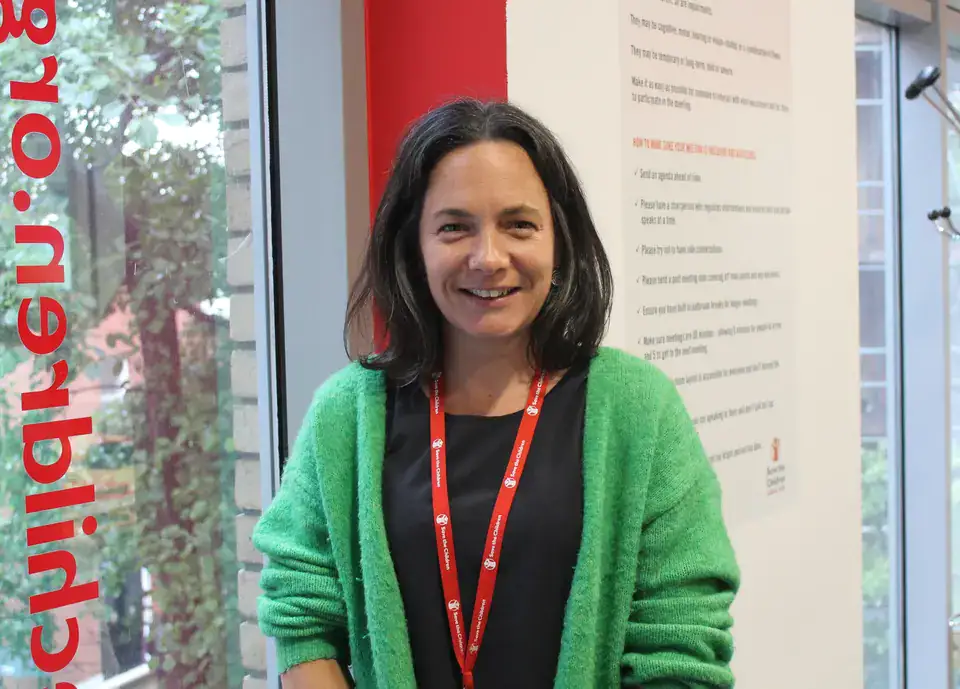
Alison Griffin is Head of Mission, Conflict and Humanitarian at Save the Children UK. Ali is a ten year veteran of Save, with roles spanning Head of UK Influencing, and Head of Conflict and Humanitarian Campaigns. She is also a Board Trustee at Play for Progress.
We worked with Ali for over two years to develop an influencing intervention that would reframe the UK political establishment’s relationship with international development. The concept was adopted by the Save Board into their organisational strategy, but was ultimately unsuccessful and did not come to fruition.
We’ve included Ali’s comments despite that for two reasons. First, you should see what working with us looks like when it doesn’t work, not just when it does. And second, to emphasise that we’d rather try the hard thing and fail, than do the easy thing and change nothing.
Tom: How did the work go from your perspective?
Ali: The first iteration of this work was about the Children and Armed Conflict Agenda—a dense UN process for holding violators of child rights to account. After our initial discussions, Cast from Clay were great at challenging that it wasn’t a new mechanism or a piece of legislation or policy that was needed–it was about implementation and the lack of political incentive for action. You were good at pivoting and saying, “let’s try something different”. We wanted to go on a journey with you, and we definitely went on that journey.
Tom: How easy did you find using the concept we developed as a funding conversation starter?
Ali: You produced a clear, pithy, impact-driven product that speaks to individual change but also systemic change. The whole point of the project was to benefit kids affected in conflict, but the route to change is to engage donors. You got that from the start.
The concept was easy to pitch because you built it with that in mind—that’s what I mean by strategic influencing. It’s exciting. Everybody I’ve spoken to has gone, “Yeah, that sounds great.” From a fundraiser’s perspective, it is gold.
Tom: Where did we add value to the process? What was it like working with us?
Ali: One of the best bits was how you developed the stages of the work, like a theory of change, but translated into the stages of the project. At every stage, you were able to draw out key target outcomes for us. Even at the very start, when you were putting together the pitch to get companies on board to reframe their business model, even at that stage you were producing really useful data.
There was really good proactive outreach to stakeholders we would never have thought about, from private sector foundations, to contacts inside the FCDO, and the Global Challenges team in Canada. We still have an ongoing relationship with several of the people we met through this process. It’s an attitude of not just doing the job but being curious about how to embrace the context you’re operating in and push it to its furthest boundaries; a curiosity to see the biggest picture possible.
The drinks nights you hosted, bringing the right people into the room, coming to various events we held to gather more intel for the wider context… these are not cost-beneficial for a consultancy to do, but they show a commitment and a curiosity to find ways to problem-solve.
Tom: How would you describe us?
Ali: Comms Plus. The Plus is absolutely impact-driven for real-world outcomes. It’s not just comms. It’s strategic influencing in a digital environment that’s volatile, and how to adapt in those scenarios.
Tom: How do we compare to other firms you’ve worked with?
Ali: I’ve worked with quite a few consultancies in my career. You’re incomparable, because you’re agile and transparent. There’s very little bureaucracy and faff and we had brilliantly robust conversations that moved the project forward without the normal power dynamics of a client/consultant relationship.
If there is a 10-person wide layer of people on a project, working in fixed ways for all clients, and the sense of ‘being right’ that comes with that—and the defensive stuff as well–it’s really hard to work together. The number of times I’ve fed back to someone that we can’t say something because our red lines are there to literally protect our staff’s lives and it’s not really understood because ‘comms expertise’ takes priority…there’s none of that with you guys —it’s much more like a joint endeavour to make the greatest impact, whilst managing the risks.
That matters because when we’re all on the same page, you can cut through to get the real work done and save time.
Tom: What advice would you give someone thinking about working with us?
Ali: Free yourself from your preconceived ideas about what you might think works. That’s not the point of hiring Cast from Clay. The whole point is they give you a fresh perspective on the problem you’re trying to solve. Allow them the freedom to deliver within the remit and framework you set, but go fly within that—you’ll get a much better outcome.
If you want to read another review, the next is with Peter Mattis, President at The Jamestown Foundation. If you would like to have an initial conversation with Tom, our CEO, to discuss a potential engagement, you can book a 15 minute call.